cmtfoi.org

Charcot Marie Tooth Registration

Uncategorized

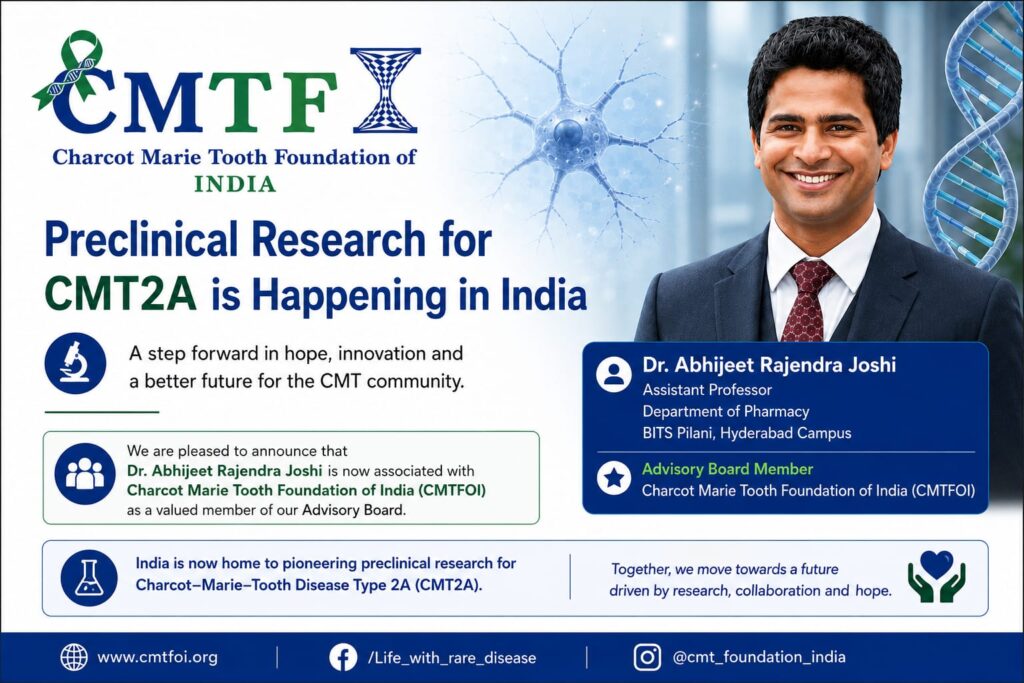
Dr. Abhijeet Rajendra Joshi Joins CMT Foundation of India Advisory Board: Advancing Hope for CMT Research in India

  Dr. Abhijeet Rajendra Joshi Joins CMT Foundation of India Advisory Board: Advancing Hope for CMT Research in India   The Charcot Marie Tooth Foundation of India (CMTFOI) is delighted to welcome Dr. Abhijeet Rajendra Joshi to its Advisory Board. His association marks an important milestone in our mission to promote research, improve patient care, and accelerate scientific progress for individuals living with Charcot-Marie-Tooth (CMT) disease in India. Dr. Joshi is an Assistant Professor in the Department of Pharmacy at BITS Pilani, Hyderabad Campus. He earned his Ph.D. in Neuroscience from the University of Cologne, Germany, followed by five years of postdoctoral research at the Baylor College of Medicine, Houston, USA. His work in neuroscience has been recognized through prestigious fellowships, including the DAAD Doctoral Fellowship and the DST INSPIRE Faculty Fellowship, and his research has received international recognition with numerous peer-reviewed publications and over 500 citations. A Major Step Forward for CMT Research in India One of the most exciting aspects of Dr. Joshi’s work is his ongoing preclinical research on Charcot-Marie-Tooth Disease Type 2A (CMT2A). Supported by the Indian Council of Medical Research (ICMR), the Department of Science and Technology (DST), and other funding agencies, his laboratory is working on the discovery and preclinical evaluation of novel SARM1 inhibitors, a promising therapeutic approach aimed at slowing or preventing nerve degeneration in CMT2A. While this research is still at the preclinical stage and is not yet available as a treatment for patients, it represents one of the few dedicated CMT2A research programs currently underway in India. It reflects the growing scientific commitment within the country to develop future therapies for inherited peripheral neuropathies. Strengthening the Bridge Between Research and Patients As an Advisory Board Member of CMTFOI, Dr. Joshi will provide scientific guidance to the Foundation’s research initiatives, patient registry, educational programs, and collaborations with clinicians and researchers across India and internationally. His expertise will help strengthen CMTFOI’s vision of creating a robust ecosystem where patients, clinicians, researchers, and policymakers work together to improve diagnosis, promote research, and prepare India for future clinical trials and emerging therapies. Looking Ahead The inclusion of Dr. Abhijeet Rajendra Joshi on the CMTFOI Advisory Board reinforces our commitment to building a strong scientific foundation for the CMT community in India. We believe that meaningful progress is achieved when patient advocacy and cutting-edge research move forward together. We warmly welcome Dr. Joshi to the CMTFOI family and look forward to working closely with him to advance research, inspire hope, and improve the lives of individuals and families affected by Charcot-Marie-Tooth disease. Together, we move closer to a future where every CMT patient has access to better diagnosis, better care, and ultimately, better treatments. -Charcot Marie Tooth Foundation of India
Uncategorized

Decoding the Dark Matter of Charcot Marie Tooth Disease: Why the Indian Cohort Holds the Key to a Global Cure

Decoding the Dark Matter of Charcot Marie Tooth Disease: Why the Indian Cohort Holds the Key to a Global Cure   Introduction Imagine trying to complete a massive, complex jigsaw puzzle while only having pieces from one corner of the box. For decades, global genomic medicine has faced a similar limitation. Although Charcot Marie Tooth disease affects millions of people worldwide, most of the available genetic data has been generated from Western populations. Peripheral nerves do not recognize geographical borders. To truly understand the biology of CMT, the scientific community must look toward one of the world’s richest sources of genetic diversity: the Indian CMT cohort. Rather than being merely a regional population, the Indian cohort represents a missing piece of the global puzzle. Insights generated from India have the potential to transform diagnosis, research, and treatment strategies for patients across the world. The Global Library Is Incomplete Without India When a person with CMT undergoes genetic testing, clinicians compare the results with international databases such as ClinVar. If a mutation has never been documented, it is frequently classified as a Variant of Uncertain Significance (VUS), leaving patients and families without clear answers. A landmark Indian genetic study revealed that 73% of the 62 distinct variants identified were entirely novel and had never been reported previously. Every newly characterized variant enriches global reference databases, improving diagnostic accuracy not only for Indian patients but also for individuals in New York, Paris, Tokyo, and countless other places. A Unique Genetic Archive In Western populations, duplication of the PMP22 gene accounts for nearly half of all CMT cases. India presents a different genetic landscape. Alongside CMT1A, there is a remarkable diversity of rare autosomal recessive and axonal forms, including CMT2 and CMT4. Mutations involving genes such as SH3TC2, MFN2, and GJB1 offer unique opportunities to study myelin degeneration and axonal dysfunction that are comparatively uncommon elsewhere. Exploring the Genome Beyond the Obvious Many individuals remain undiagnosed even after Whole Exome Sequencing because important disease causing variants can lie outside protein coding regions. Emerging work from Indian researchers has demonstrated the value of Whole Genome Sequencing in identifying pathogenic variants within regulatory and non coding regions, including GJB1 intronic variants and LMNA 5′ UTR variants. These findings provide an important framework for solving genetically unresolved CMT cases around the world. Strengthening the Global Search for a Cure Gene therapies, antisense oligonucleotides, and other precision treatments are rapidly advancing through research pipelines. However, therapies intended for worldwide use must be evaluated across diverse genetic backgrounds. Including the Indian CMT population in research and clinical development helps ensure that future therapies are effective, reliable, and applicable to a broader global population. A truly global cure must reflect global genetic diversity. Conclusion The search for a cure for Charcot Marie Tooth disease is a shared international mission. The Indian CMT community is not simply seeking answers for itself; it offers an extraordinary source of scientific knowledge that can accelerate discoveries benefiting patients everywhere. Investing in Indian CMT research is not only an act of inclusion but also a scientific necessity. By embracing this diversity, the global community moves one step closer to more accurate diagnoses, better therapies, and ultimately a cure. Author: Dr.Priyanshu Agrawal Co‑Founder and Director Charcot Marie Tooth Foundation of India
Uncategorized

The Hidden Epidemic: Why Demotivation Spreads Faster Than Motivation

The Hidden Epidemic: Why Demotivation Spreads Faster Than Motivation Over the years of working in the leadership role at my workplace and now for a few months with patients, caregivers, and advocacy groups, I have observed something that is rarely discussed but profoundly impacts outcomes: “Motivation spreads. But demotivation spreads faster.” For individuals living with rare and chronic diseases, motivation is not merely a mindset—it is often the difference between participation and withdrawal, independence and dependency, progress and decline. A patient may start by skipping a small daily activity because it feels difficult. Then another. And another. Gradually, they begin relying more on others for things they are still capable of doing themselves. This transition is often so subtle that neither the patient nor the caregiver notices it happening. “What begins as support can unintentionally become overprotection.” On the part of parents or caregivers, while care and compassion are essential, but excessive dependence can slowly erode confidence, self-belief, and ultimately self-motivation of the patients. The challenge is not simply to help patients live with a condition, but to empower them to remain active participants in their own lives. “Independence is not the opposite of support. It is the goal of support.” The same principle applies to leadership in every sphere of life—whether in healthcare, business, research, patient advocacy, public service, education, or even within a family. Every leader carries responsibility beyond their own circumstances. People look to leaders not because they are immune to challenges, but because they continue moving forward despite them. In rare disease communities, this responsibility is often even greater. Many patient advocates and organization leaders are not merely observers—either they are patients themselves or the parents. They carry their own physical or emotional challenges  while simultaneously carrying the hopes of hundreds or thousands of others. They speak at conferences & online platforms; engage with clinicians & researchers; advocate for policy changes, build patient registries, support newly diagnosed families, and push for better care. Yet behind these efforts are individuals who face the same uncertainties as everyone else. “And when leaders struggle, something important happens.” Motivation requires effort, consistency, and deliberate action to spread. Demotivation, however, often spreads effortlessly. A moment of doubt can travel through a community much faster than months of encouragement. People are naturally drawn towards certainty and comfort. Unfortunately, negativity often feels more comfortable than resilience because it demands less effort. This is why demotivation can spread through a group, a family, an organization, or an entire community with surprising speed. That is why protecting one’s motivation is not being selfish—it is a responsibility.   What I’ve Learned ·       Self-motivation is the foundation of leadership. You cannot consistently inspire others if you have abandoned hope yourself. ·       Independence builds confidence. Patients should be encouraged to do what they can, even when progress feels tiny. ·       Support should empower, not replace. The objective of caregiving is not dependence; it is enabling capability. ·       Communities must guard against collective negativity. Challenges should be acknowledged, but hopelessness should never become the dominant narrative. ·       Leaders need support too. Those who motivate others also need spaces where they can recharge, learn, and regain perspective. In healthcare, we often focus on medicines, therapies, technologies, and research. All of these are important. But progress also depends on something less tangible: “The belief that improvement is possible.” Because motivation can help a patient to consistently do the rehabilitation, encourage a family to seek proper diagnosis, inspire people’s participation in research, strengthen an advocacy movement, improve quality of life, and sometimes even change the course of a life. Every conversation, every action, and every response contributes to the culture of a community. We can spread hope, resilience, and possibility. Or we can spread doubt, dependency, and defeat. Motivation is contagious. Demotivation is even more contagious.   “The question is not whether we influence others. The question is what we are spreading.”   These reflections resonate across patient advocacy and leadership alike. How do you guard against demotivation in your own community? #PatientAdvocacy #RareDiseases #Leadership #Motivation #Caregivers #CommunityBuilding   This blog is written by Harsh Singla  

Uncategorized

If there is a rare disease, there should be a patient registry.

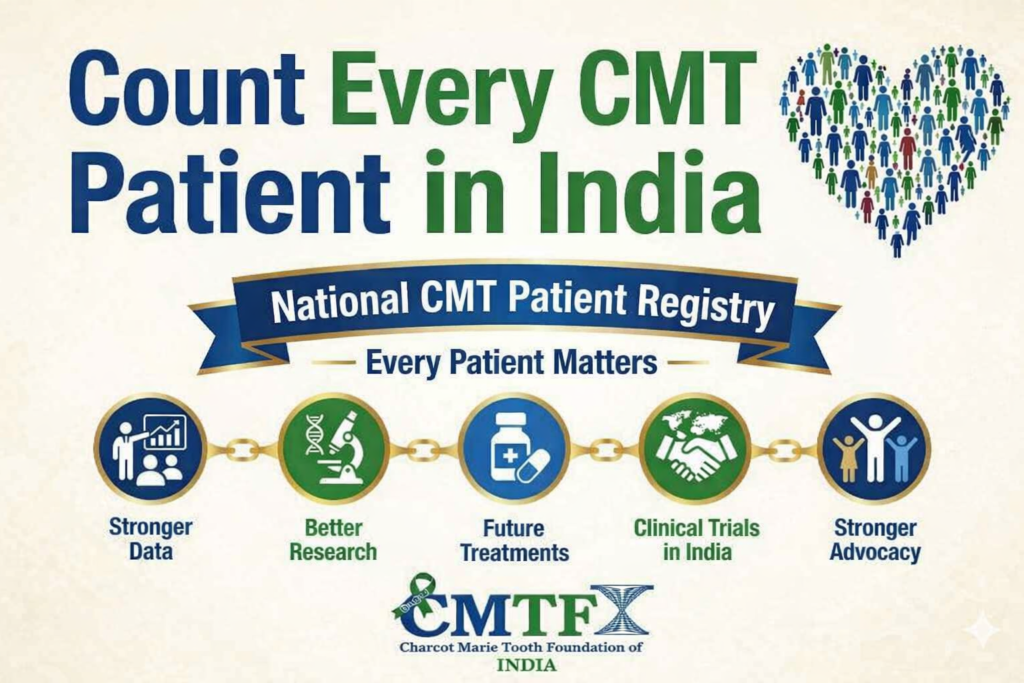
If there is a rare disease, there should be a patient registry.   When a rare disease is identified, the immediate focus is often on finding a treatment. Yet, one of the most important questions remains unanswered: Do we truly understand the disease? Before therapies, before clinical trials, and before biomarkers, comes the Data. And the most powerful way to systematically collect that data is through a patient registry. For clinicians, geneticists, and researchers, a patient registry is much more than a database. It is a scientific foundation that supports answers to critical questions, such as: How many patients & families are affected with this disease? Where are they located? What could be the origin or root-cause? What genetic variants are involved? How does the disease progress over time? Why do some patients progress faster than others? Which clinical outcomes matter most to patients and families? Patient registries make it possible to conduct natural history studies, which are essential for understanding how a disease evolves in the absence of treatment. Without this knowledge, it becomes difficult to measure whether a new therapy is truly effective. Registries also help researchers move from observation to discovery. They enable the identification of disease patterns, support biomarker development, reveal genotype-phenotype correlations, and help uncover the underlying molecular mechanisms driving disease progression. For industry and clinical trial sponsors, registries are often the first step in assessing trial readiness. They provide insights into patient numbers, geographic distribution, disease severity, and potential recruitment pathways. Many successful rare disease trials around the world were built upon years of registry data. Beyond research, registries have another important role: they bring visibility to conditions that are often misunderstood. By generating reliable evidence, they help dispel myths, reduce stigma, strengthen advocacy efforts, and support evidence-based policy making. In many ways, a patient registry serves as a roadmap: It helps identify immediate needs such as proper diagnosis and access to care. It informs intermediate goals such as biomarker development and therapeutic research. It supports the ultimate goal of disease-modifying treatments and, one day, a cure. As physicians, geneticists, researchers, patient organizations, and policymakers work together to advance rare disease research, one principle remains universally relevant: You cannot effectively study, manage, or treat what you do not systematically understand. And that understanding begins with a patient registry. If there is a rare disease, there should be a patient registry, because: No registry → limited understanding. Limited understanding → limited research. Limited research → limited therapeutic progress. This is precisely why the National CMT Patient Registry was established in India—to create a foundation for natural history studies, biomarker discovery, clinical trial readiness, and future therapeutic development for Charcot-Marie-Tooth disease. Registry: https://cmtfoi.org/patient-registry/ #RareDiseases #PatientRegistry #CharcotMarieTooth #CMTFoundationOfIndia

Scroll to Top