 The Hidden Epidemic: Why Demotivation Spreads Faster Than Motivation
Over the years of working in the leadership role at my workplace and now for a few months with patients, caregivers, and advocacy groups, I have observed something that is rarely discussed but profoundly impacts outcomes:
“Motivation spreads. But demotivation spreads faster.”
For individuals living with rare and chronic diseases, motivation is not merely a mindset—it is often the difference between participation and withdrawal, independence and dependency, progress and decline.
A patient may start by skipping a small daily activity because it feels difficult. Then another. And another. Gradually, they begin relying more on others for things they are still capable of doing themselves. This transition is often so subtle that neither the patient nor the caregiver notices it happening.
“What begins as support can unintentionally become overprotection.”
On the part of parents or caregivers, while care and compassion are essential, but excessive dependence can slowly erode confidence, self-belief, and ultimately self-motivation of the patients. The challenge is not simply to help patients live with a condition, but to empower them to remain active participants in their own lives.
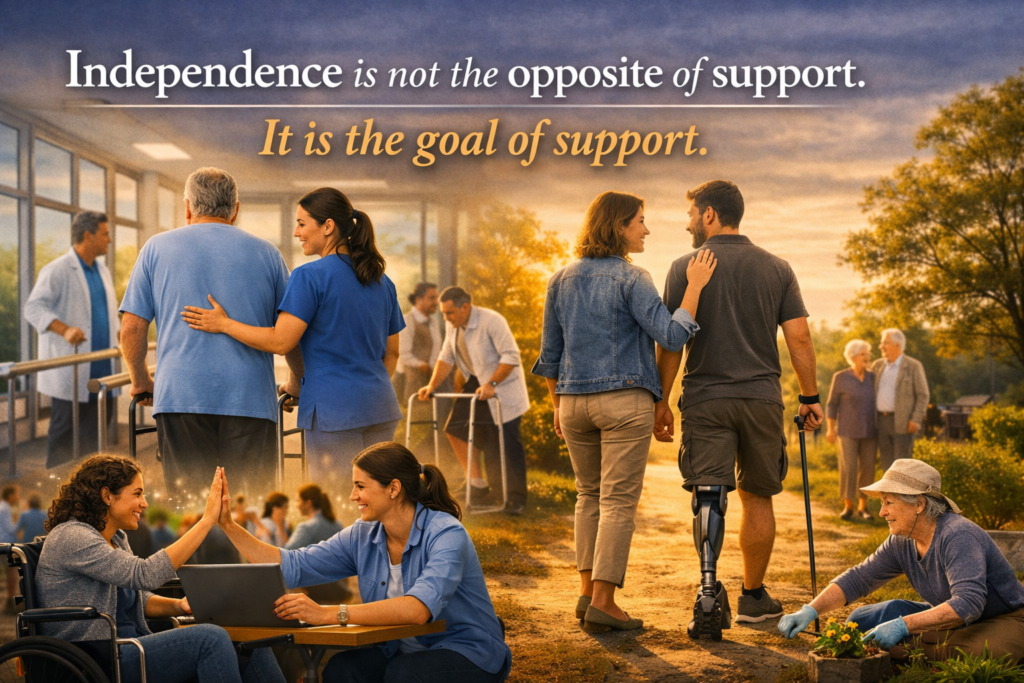
“Independence is not the opposite of support. It is the goal of support.”
The same principle applies to leadership in every sphere of life—whether in healthcare, business, research, patient advocacy, public service, education, or even within a family.
Every leader carries responsibility beyond their own circumstances. People look to leaders not because they are immune to challenges, but because they continue moving forward despite them.
In rare disease communities, this responsibility is often even greater. Many patient advocates and organization leaders are not merely observers—either they are patients themselves or the parents. They carry their own physical or emotional challenges while simultaneously carrying the hopes of hundreds or thousands of others.
They speak at conferences & online platforms; engage with clinicians & researchers; advocate for policy changes, build patient registries, support newly diagnosed families, and push for better care. Yet behind these efforts are individuals who face the same uncertainties as everyone else.
“And when leaders struggle, something important happens.”
Motivation requires effort, consistency, and deliberate action to spread. Demotivation, however, often spreads effortlessly. A moment of doubt can travel through a community much faster than months of encouragement.
People are naturally drawn towards certainty and comfort. Unfortunately, negativity often feels more comfortable than resilience because it demands less effort. This is why demotivation can spread through a group, a family, an organization, or an entire community with surprising speed.
That is why protecting one’s motivation is not being selfish—it is a responsibility.
What I’ve Learned
· Self-motivation is the foundation of leadership. You cannot consistently inspire others if you have abandoned hope yourself.
· Independence builds confidence. Patients should be encouraged to do what they can, even when progress feels tiny.
· Support should empower, not replace. The objective of caregiving is not dependence; it is enabling capability.
· Communities must guard against collective negativity. Challenges should be acknowledged, but hopelessness should never become the dominant narrative.
· Leaders need support too. Those who motivate others also need spaces where they can recharge, learn, and regain perspective.
In healthcare, we often focus on medicines, therapies, technologies, and research. All of these are important. But progress also depends on something less tangible:
“The belief that improvement is possible.”
Because motivation can help a patient to consistently do the rehabilitation, encourage a family to seek proper diagnosis, inspire people’s participation in research, strengthen an advocacy movement, improve quality of life, and sometimes even change the course of a life.
Every conversation, every action, and every response contributes to the culture of a community.
We can spread hope, resilience, and possibility.
Or we can spread doubt, dependency, and defeat.
Motivation is contagious.
Demotivation is even more contagious.
“The question is not whether we influence others. The question is what we are spreading.”
These reflections resonate across patient advocacy and leadership alike. How do you guard against demotivation in your own community?
#PatientAdvocacy #RareDiseases #Leadership #Motivation #Caregivers #CommunityBuilding
This blog is written by