Dr. Abhijeet Rajendra Joshi Joins CMT Foundation of India Advisory Board: Advancing Hope for CMT Research in India
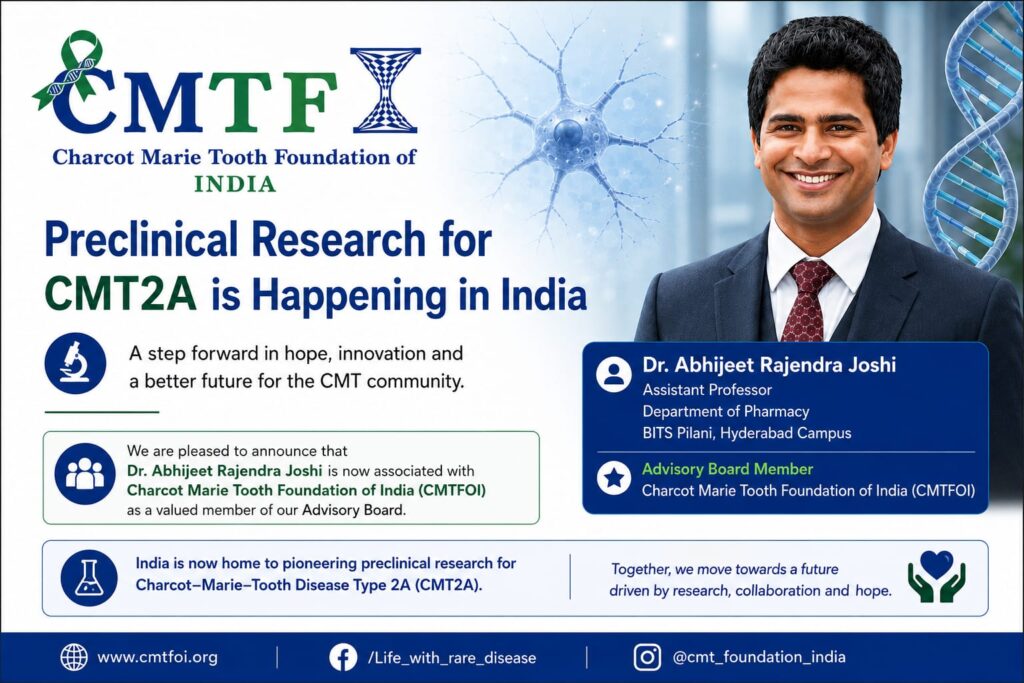
Dr. Abhijeet Rajendra Joshi Joins CMT Foundation of India Advisory Board The Charcot Marie Tooth Foundation of India (CMTFOI) is delighted to welcome Dr. Abhijeet Rajendra Joshi to its Advisory Board. His association marks an important step in our mission. We aim to promote CMT research, improve patient care, and support scientific progress for people living with Charcot-Marie-Tooth (CMT) disease in India. Dr. Joshi is an Assistant Professor in the Department of Pharmacy at BITS Pilani, Hyderabad Campus. He earned his Ph.D. in Neuroscience from the University of Cologne, Germany. Following his Ph.D., he completed five years of postdoctoral research at Baylor College of Medicine in Houston, USA. His work in neuroscience has received several prestigious fellowships. These include the DAAD Doctoral Fellowship and the DST INSPIRE Faculty Fellowship. His research has also received international recognition through numerous peer-reviewed publications. To date, his work has received more than 500 citations. A Major Step Forward for CMT Research in India One of the most exciting aspects of Dr. Joshi’s work is his preclinical research on Charcot-Marie-Tooth Disease Type 2A (CMT2A). The Indian Council of Medical Research (ICMR), the Department of Science and Technology (DST), and other funding agencies support this research. His laboratory is studying novel SARM1 inhibitors. These compounds may offer a potential therapeutic approach for CMT2A. Researchers are exploring their ability to slow or prevent nerve degeneration. The research remains at the preclinical stage. It is not currently available as a treatment for patients. However, the program represents an important area of CMT2A research in India. It also reflects the growing focus on developing future treatments for inherited peripheral neuropathies. Strengthening the Bridge Between Research and Patients As an Advisory Board Member of CMTFOI, Dr. Joshi will provide scientific guidance to the Foundation. His expertise will support our research initiatives, patient registry, and educational programs. He will also contribute to collaborations with clinicians and researchers in India and around the world. These partnerships can help strengthen research and improve knowledge of CMT. His involvement will further strengthen CMTFOI’s vision. We aim to build a strong ecosystem that connects patients, clinicians, researchers, and policymakers. Through this collaboration, these groups can work together to improve CMT diagnosis and promote research. Their efforts can also help prepare India for future clinical trials and emerging therapies. Looking Ahead Dr. Abhijeet Rajendra Joshi’s addition to the CMTFOI Advisory Board strengthens our commitment to CMT research in India. Meaningful progress happens when patient advocacy and scientific research move forward together. We warmly welcome Dr. Joshi to the CMTFOI family. His expertise will help us advance CMT research and support the needs of the CMT community. We look forward to working with him to inspire hope and improve the lives of people and families affected by Charcot-Marie-Tooth disease. Together, we move closer to a future where every CMT patient has access to better diagnosis, better care, and ultimately, better treatments. — Charcot Marie Tooth Foundation of India