Artificial Intelligence (AI)
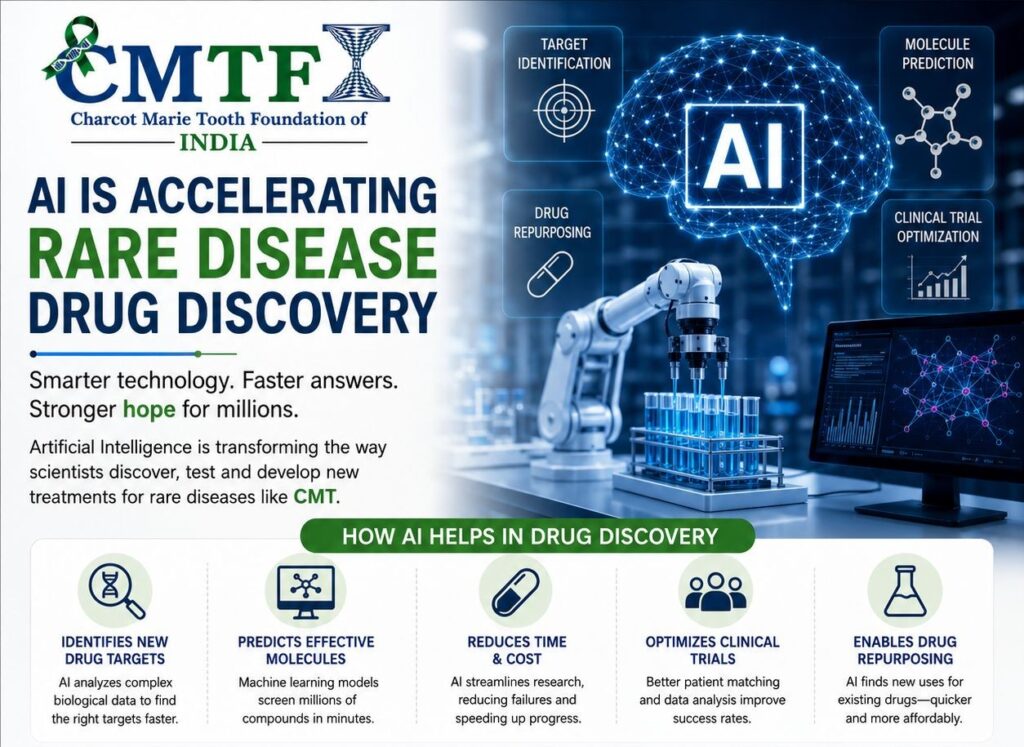
is rapidly transforming healthcare and biomedical innovation. This is especially true in rare diseases such as Charcot-Marie-Tooth (CMT) disease. Researchers, biotechnology companies, and scientific institutions around the world are using AI-powered tools to better understand diseases. AI is also helping accelerate drug discovery and clinical research. It may also support the development of future therapies.
Rare genetic disorders like CMT present unique scientific challenges. They often involve complex genetics and variable disease progression. Large patient datasets are also limited. AI-driven technologies can help address these challenges. They enable faster analysis of biological, clinical, genetic, and movement-related data. These advances are creating new possibilities in precision medicine, disease modeling, biomarker identification, patient monitoring, and therapeutic discovery.
Rare genetic disorders like CMT present unique scientific challenges. They often involve complex genetics and variable disease progression. Large patient datasets are also limited. AI-driven technologies can help address these challenges. They enable faster analysis of biological, clinical, genetic, and movement-related data. These advances are creating new possibilities in precision medicine, disease modeling, biomarker identification, patient monitoring, and therapeutic discovery.
Rare genetic disorders like CMT present unique scientific challenges. They often involve complex genetics and variable disease progression. Large patient datasets are also limited. AI-driven technologies can help address these challenges. They enable faster analysis of biological, clinical, genetic, and movement-related data. These advances are creating new possibilities in precision medicine, disease modeling, biomarker identification, patient monitoring, and therapeutic discovery.
DANCER
is an emerging AI-assisted movement analysis tool. It was developed by Dr. Wolfgang Pernice and the CMT Research Foundation in collaboration with Columbia University. DANCER is designed to analyze motor function and movement patterns in people affected by CMT. It uses simple 2D smartphone video recordings.
The platform uses advanced computer vision and AI-based reconstruction methods. It can generate detailed 3D whole-body movement models. This helps researchers measure gait, balance, and functional changes over time. These methods may improve disease tracking and support future clinical research.
AI is also influencing the future of rare disease drug discovery. VoyageR, developed by ReviR Therapeutics, is one example. The platform explores AI-enabled approaches for identifying RNA-targeted small-molecule therapies. These approaches may have applications in neurological and genetic disorders, including CMT.
VoyageR combines machine learning, RNA biology, molecular modeling, and structural analysis. These computational systems can evaluate large chemical libraries quickly. They can also identify molecules with potential therapeutic relevance. Such approaches may help reduce the time and cost of early-stage drug development.
AI in CMT Research
In addition to movement analysis and drug discovery, AI-assisted technologies are being explored for:
- Identifying new therapeutic targets
- Exploring drug repurposing strategies
- Discovering biomarkers and predicting disease progression
- Optimizing clinical trials and patient stratification
- Interpreting genetic data and supporting precision medicine
- Analyzing large-scale patient data through registries and digital health systems
Artificial intelligence does not replace laboratory science or clinical expertise. Patient participation also remains essential. However, AI has the potential to support and accelerate scientific discovery in rare neurological diseases.
The global CMT research ecosystem continues to evolve. AI is becoming an important part of this progress. Its integration with computational biology, patient registries, and collaborative research may improve our understanding of CMT disease. It may also create new opportunities for future therapies and better care for people and families affected by CMT.
Disclaimer
This article is intended solely for educational and awareness purposes. References to DANCER, VoyageR, artificial intelligence platforms, research initiatives, organizations, and emerging technologies are based on publicly available information from their respective institutions and independent scientific sources.
The Charcot Marie Tooth Foundation of India does not claim ownership of the technologies, platforms, trademarks, research projects, or associated intellectual property mentioned in this article unless explicitly stated.
References to ongoing research or investigational approaches should not be interpreted as medical advice, endorsement, or guarantees of treatment outcomes.